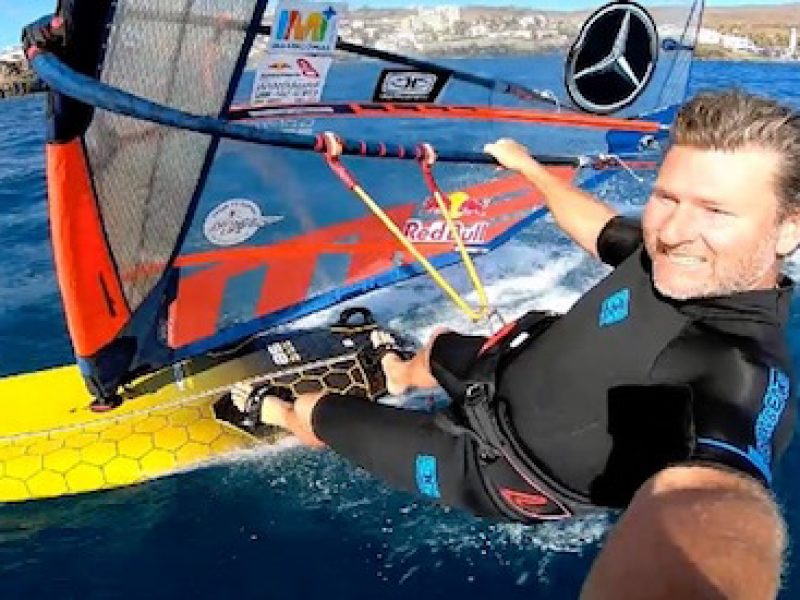
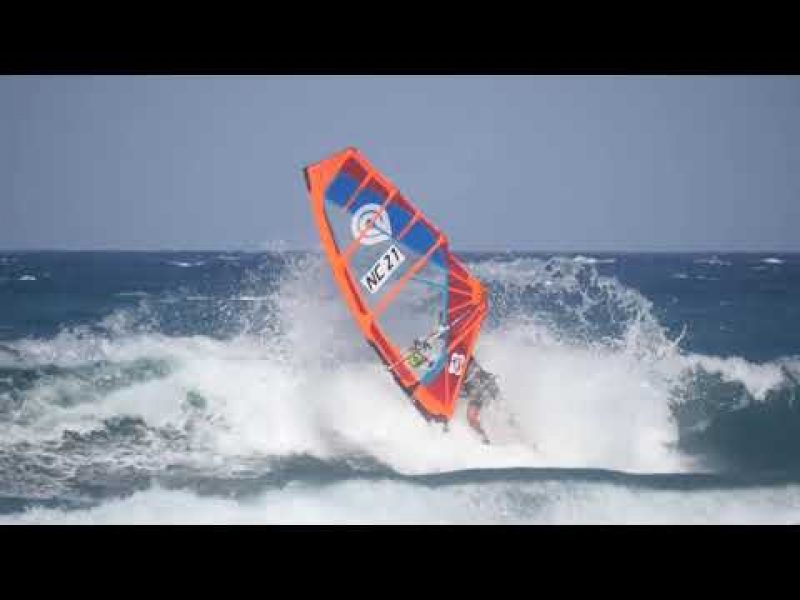
Let’s face it, getting to the start line at Lüderitz involves remortgaging the house for most of us, but if you’ve ever fancied competing in a speed event then Bjorn Dunkerbeck has come up with a genius idea that means you can enter from your home spot, which is pretty handy in these Covid-19 times! The third period of the Dunkerbeck GPS Speed Challenge is set to commence on the 1st of October and will run through until the 1st of December. The philosophy of the competition is to introduce more windsurfers into the speed discipline through a pro-am event, open to all ages. To enter you simply create an account on www.gps-speedsurfing.com, subscribe to the event and make sure you use a GPS that is from the approved list on https://www.gps-speedsurfing.com/default.aspx?mnu=item&item=GPSInfo
The format according to Bjorn is easy! Simply record you top speed over a distance of 250m and post your results on the GPS site. Any windsurfer can do this from youths all the way through to the likes of Bjorn’s father Eugen who is 75! It is a fun format and accessible to any windsurfer anywhere on the planet! Bjorn reckons that there have been plenty of incredible speeds coming from the UK especially from West Kirby! Prizes will be awarded to the top speeds from the different categories from the event sponsors.
There will also be a foil ranking which Bjorn believes to be the future of light wind racing. With the Dunkerbeck Speed Challenge, you can compete with or against your parents or alongside all like-minded windsurfers around the globe. New speed spots have been discovered and new names will come out of this challenge! There are no limits to where you take part or on what equipment you want to ride!
Already planned for 2021 is three to four more speed sailing periods and together with all the participants, Bjorn Dunkerbeck is hoping the event will help promote windsurfing, which in his immortal words is ‘The greatest sport there is!’. We concur!
“This year, in this exceptional situation that the whole world is experiencing with all the limitations that are being imposed on us, we are happy to continue with the competition format that we have been carrying out since 2015 and to make it even more interesting for all windsurfers.
The online gps- based racing format on www.gps-speedsurfing.com is a perfect way to compete and maintain the social distancing at the same time.
Due to current COVID-19 restrictions unfortunately the Defi –Event, where we are organising since six years “a race in the race” had to be postponed to next year but
online we can compete!
To make it more accessible to all windsurfers in the world and because there are many more spots where you can do this distance, we decided to rank the fastest average speed on 250m.
Because it’s also our main
motivation to
mobilize
the entire windsurfing community and regain relative normality through our sport as soon as possible using current technology to compete together from any country in the world without traveling, while promoting windsurfing as an ecological sport and healthy lifestyle.
Whats NEW this year?
this year we’ll also rank:
YOUNG GUNS (all kids under 18 years- from 2002 on)
GRAND MASTER+ (50 years+ born in 1970 and later)
FOIL
ALPHA RACE
(What’s alpha race? A small explanation for those who do not know what it is, is to do a distance of 250 metres a jibe and another 250 metres back. The trick is that there can be no more than 50m between the starting point and the return point, and this is where the ability of the windsurfer to set the fastest round-trip course and tell you about the pass comes into play.)
So everybody starts to tune his gear because this year the fastest can win:
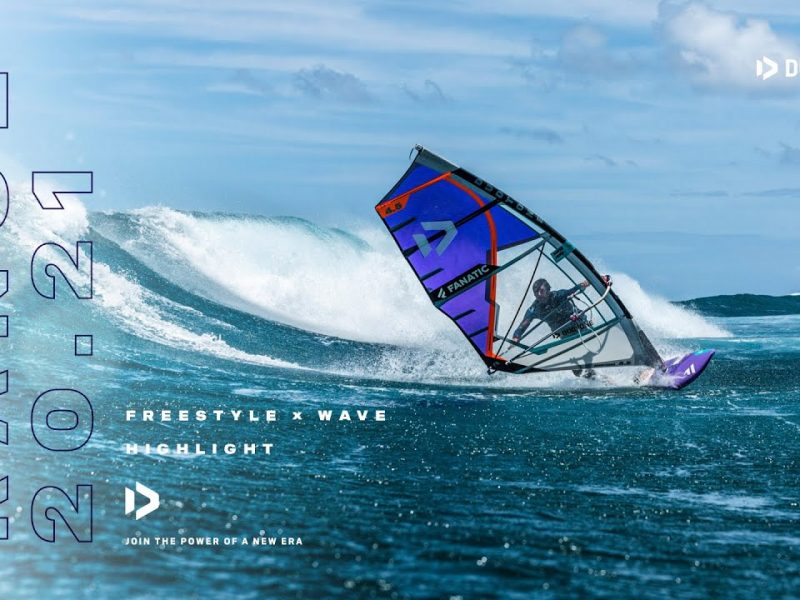
2021 DUOTONE AVENGERS: SUPER HERO | SUPER STAR | IDOL LTD
Check out this action packed clip of the 2021 Duotone Super Hero, Super Star and Idol LTD featuring Marc Pare, Victor Fernandez, Arthur Arutkin, Adrien Bosson and Adam Lewis!
In keeping with summer, the high season for newcomers to windsurfing, we go back to basics this month and look at the fundamentals of rig tuning. Getting your rig to its optimal state is all about finding a base to work from and then tune, experiment and reflect from there. This piece is not going to disappear off in a haze of luff curve, flex response time and other fancy jargon, but rather provide you with the basics that I have seen benefit hundreds of people I have coached.
The main areas we will cover are: harness line length, spread and position, boom height and the main trimming variables of both outhaul and downhaul.
3 CORNERS AND 3 SIDES
When I am coaching, I love to ask my people questions, engage them and help them become better at self coaching, so they can continue to ask themselves questions and the progression continues. One of my favourite questions is what are the names of the 3 corners and 3 sides of the sail?
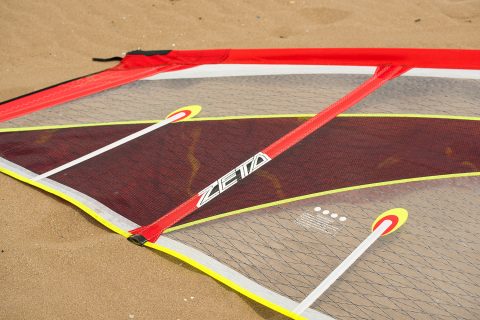
For corners, the bottom corner is called the tack, the top corner is called the head and the back corner (where you look mid gybe) is called the clew.
For sides, the bottom side is called the foot. A freeride sail has a low foot to help keep power down low for blasting, whilst a wave sail will have a higher foot for manoeuvrability. The leading edge of a sail is called the luff, with the mast going in the ‘luff tube’. To luff can also mean head upwind or sheet out. Opposite the luff, is the trailing edge, known as the leech.
HARNESS LINE LENGTH
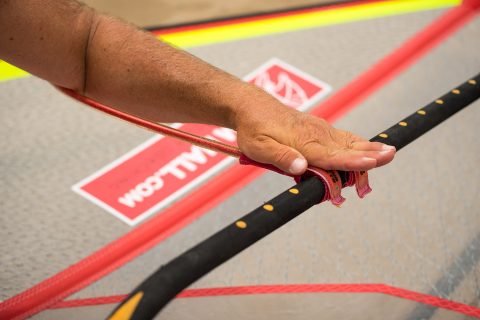
This subject can be very contentious, but I advocate long lines so the sail can work with you and you are in a position that is fluid and in balance with the sail’s power. A greater distance from the rig in a straight line means you are more likely to maintain this in a move and so have a higher likelihood of completion. Longer lines also facilitate easy hooking in and out, which will smooth out your transition entrances and exits. Longer lines also get the rig more upright and therefore more efficient. The best way to embrace long lines is to sail one handed, as you have long heard me champion. Please note it is not too long a line that causes you to unhook, it is raising our hips and bending our arms in, a common ill in windsurfing.
The measure I use in the picture has worked with hundreds of sailors and utilises your actual forearm length, as people can be tall with medium arms or shorter with long arms. Try it out and if you are going from short to long then you can transition gradually into the length if you so wish.
HARNESS LINE POSITION
Your front harness line position depends on the type of sail and size of sail. A bigger sail has the power point further back, and where the sail pulls from will also move further back as we get more powered up. Some sails and brands of sails have a more aft power point and some more forward, so get some intel and find out what sort your sail is and reflect too on where the sail is pulling from.
Here are some ways to find your front line position, but please know that this position is best felt on the water sailing along:
Go hand by hand down the boom, starting at the front, and at around 5 hand widths for a medium sail, 6 for bigger, you will often be on the money. Do the same on both sides of the boom and then go out on the water and see where the pull is coming from and shift your lines a few cms in the relevant direction. So if the pull is more from the front hand, shift your lines forward and vice versa.
You can also lay your arm down the boom, with your elbow at the front and the tips of your fingers can often give a good starting point for the front line.
Many booms have markings on them and so you can use the dots, and note these positions. One of my booms is 3.5 dots for smaller sails, 4 dots for medium sails and 5 dots for 6.5 / 7.0, as an example.
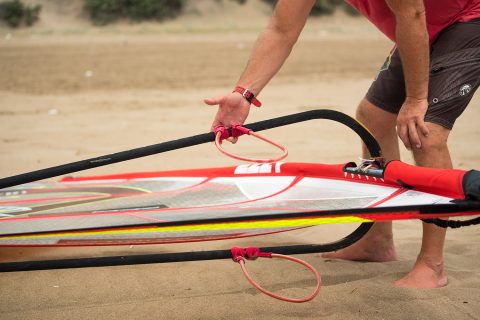
Lifting the boom with one finger also really works, as in the pic. The power point is where the sail is the deepest and this is also where the sail will balance if dangled and you can then place your lines either side of that point.
HARNESS LINE WIDTH
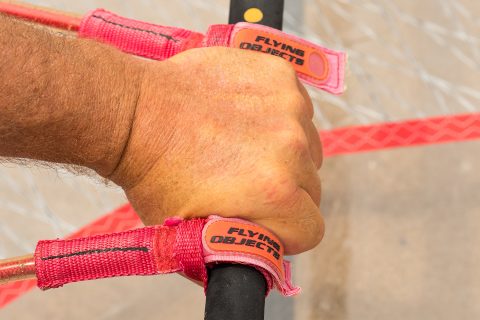
When coaching I encourage people to ‘feel the rig’ and this is easier to achieve with our hands closer together. This also means you can get the rig further away from you, more upright and your hands very close together for sailing upwind and top turns in wave riding as an example. I favour one finger apart, other people 2 – 3 fingers apart, but the max should be only a palm’s width. Why I hear you cry, well too wide means the front hand creeps forward (decreasing the power from the rig) and the backhand creeps back, where it can oversheet the sail when getting planing or hitting a lull.
BOOM HEIGHT
This is very much a personal preference, so here I will just advise how to place it at a consistent height and how best to measure this height.
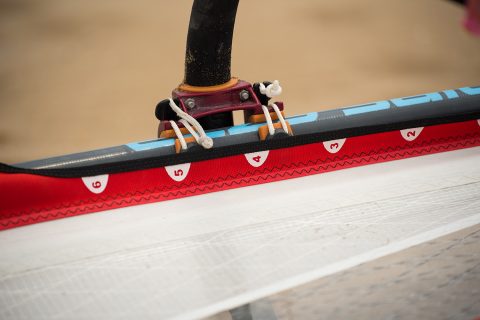
Refer to the boom cut out as many sails have numbers on their cut out. Beware that some sail brands have high boom cut outs and some lower, so find what works best for you. On my Ezzy sails I know position 5 is high, 3.5 is low and 4 is around medium.
You can also use the tail of board and see how many fingers the boom is off the tail when the rig is laid down next to it with the mast foot attached. One finger off or on the tail is low and a hand width or more is getting high.
You can also stand next to the rig on the board for a guide, with armpit being low, shoulder being medium, neck height being high.
It is important to understand the effects of boom height on your sailing:
A higher boom or moving the boom up produces power and helps you get planing.
A lower boom, or moving the boom down, gives you more control.
Moving the boom down also helps with moves and wave riding, but will challenge you more in your planing.
Note that if the boom is too far up, you won’t be able to bend the back leg enough to get planing comfortably.
Boom heights, in general, have moved down.
You would be surprised how much more control you have when very overpowered if you move your boom down and also how just raising your boom slightly will help you get planing in marginal condi
DOWNHAUL
Downhaul (DH) has a major effect on a sail’s power and control, so adjustments to DH should be very small. More DH gives more control as the sail is set flatter. Less DH gives more power as the sail is fuller and produces more lift. Don’t be frightened to really experiment at the ends of the spectrum. I have set my wave sails very very full for float and ride and very very flat when maxed out. My own preference is a slightly flatter set sail as it is better in moves and I compromise on planing with this, but get the benefit of the sail being lighter through the air.
OUTHAUL
I must admit I love tweaking the outhaul (OH) to get the best out of every session. You can make your changes in the shallows, or out the back in a wave break and benefit immediately from more control or power. With it being so easy to adjust it is surprising how few people tune it. Often when coaching we do a feedback loop and people say they were overpowered and I ask them what did you do about that? Sometimes, if it is manageable, I enthuse them to increase their outhaul so they can stay on the same sail if it is cutting up rough and just tough it out and learn to be ‘comfortable with being uncomfortable,’ and often after 20 minutes of crazy times the wind drops back down anyway, so a sail change would not have been beneficial.
Therefore my main tip here with OH is to get used to changing your outhaul on the beach, in the shallows and even in deep water. This stops you having to change sails as much so we get more water time. It not only gives you more control when you tension the OH but it can also give you a big boost in power if you ‘relax’ it too.
RRD boards, wetsuits & softwear, Ezzy sails & Black Project fins sponsor Jem Hall. Get him live and direct on one of his highly acclaimed coaching holidays, but be quick as they are selling out – check out his website
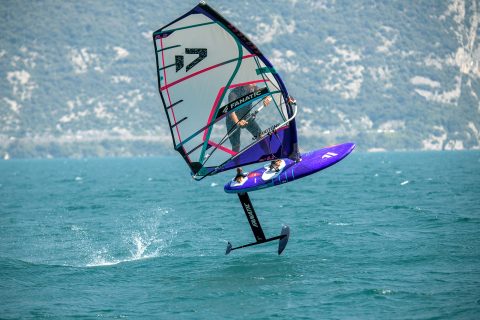
More new toys released from Fanatic to cater for your foiling and wing foiling needs!
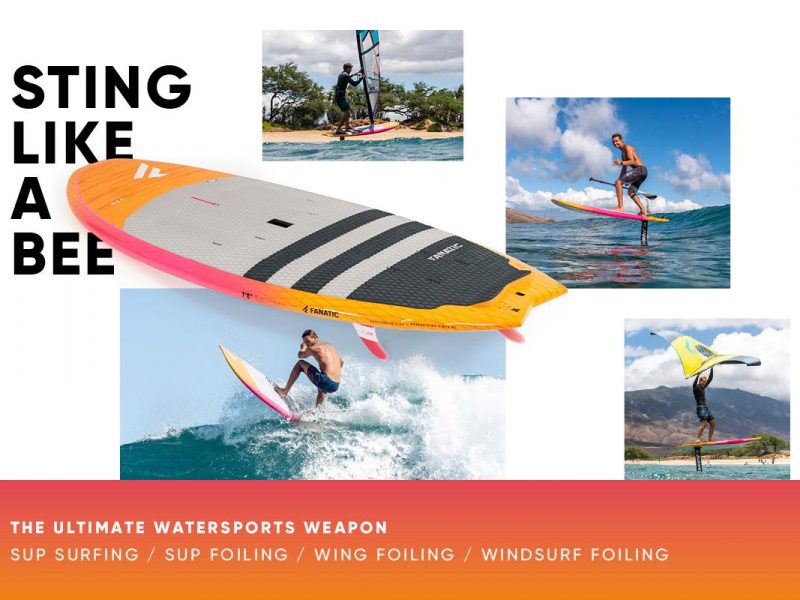
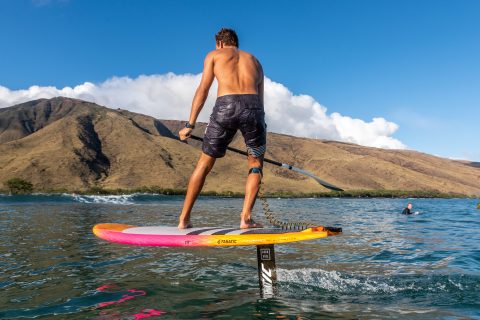
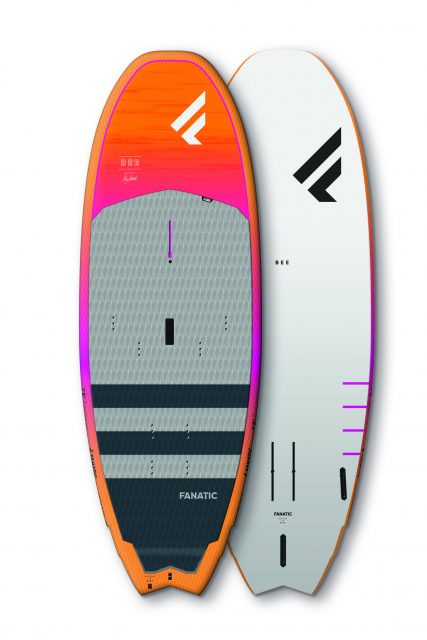
Bee:Our new Bee is the ultimate watersports-weapon. We’ve packed four different dimensions of pure fun into one board: SUP Surfing, SUP Foiling, Wing Foiling and Windsurf Foiling – you decide on the setup you ride.
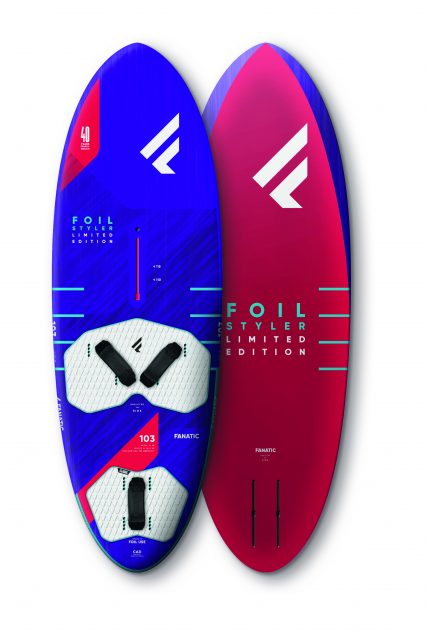
Foilstyler:
The brand new Foilstyleris designed for progressive foilers with their focus on manoeuvres rather than straight line performance only.
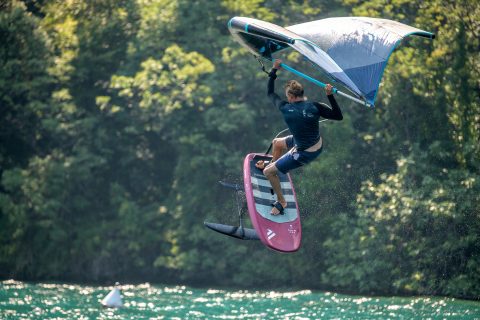
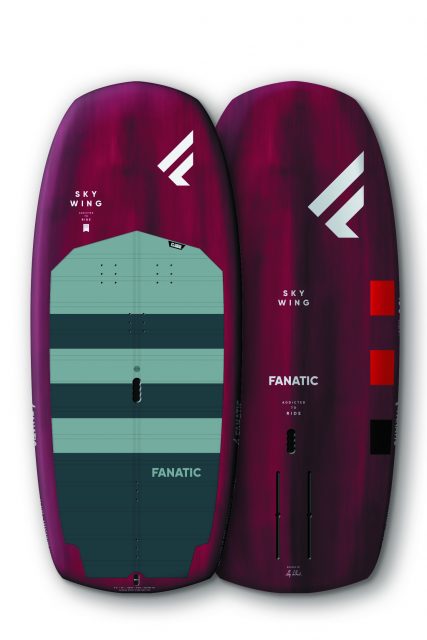
Sky Wing (new sizes):
The Sky Wing is our dedicated board range for Wing Foiling. The ultra-compact shapes feel minimal when in flight mode but are loaded with volume for an easy start and maximum stability while floating.
The latest additions 5’8” and 6’0” are focussed on the earliest take-off possible with minimal board size, but plenty of volume.
German wave sailor, Lena Erpenstein brings us this clip from her time in Western Australia last winter. It was an epic trip with many great moments and sessions to remembered. Lena even made the soundtrack herself; check it out!
Fanatic are celebrating 40 years in the business in 2021 with a history of producing iconic boards and have just released their new designs!
Ultra Skate Boa Edition 2021:
Icon meets Icon! The legendary optics of Fanatics late 80’s Ultra Boa gives the final touch to the 2021 Ultra Skate – one of our 40YRS anniversary models. The record World Title winning Skate has shaped the past, present and future of modern freestyle.
Ultra Grip / Grip XS Mosquito Edition 2021:
The Ultra Grip Mosquito Edition celebrates Fanatics 40th anniversary with a blend of iconic graphics from our history combined with the most successful wave shape of today! The highly adaptable Grip enables you to ride your wave – your way, without compromise. The Grip XS is our dedicated performance waveboard for the future stars of our sport.
FreeWave 2021:
our legendary FreeWave DNA, the FreeWave is the true chameleon – ready to adapt and excel in all conditions. From flatwater blasting to bump & jump to waves, the FreeWave is the one board that takes it all in its stride, and will boost your level across a bigger range of conditions than ever.
Fanatic Mamba:
The brand-new Mamba takes the place of the Stubby in our line-up and shines with similar attributes in sloppy waves, but comes with improved performance for when the conditions turn on.
Philippe Bru is the man who has put long distance windsurf racing on the map and most certainly has a vision for our sport, he gives us an insight into his life and his legendary Défi Wind events.
Words Philippe Bru// Photos Jean Siouville, Christophe Gaston, Jean-Marc Cornu & Hoalen.com
ROOTS I was born in Africa 53 years ago; it is where I spent the first 20 years of my life! During a summer stay in France in 1977 when I was 13 years old I discovered windsurfing through my uncle, one of the first windsurfers in the Mediterranean. Back in Dakar, Senegal, our “elders” had brought back some windsurfing kit and quickly set up a structure to take people from initiation to competition standard. And now here I am in 2020, still with a passion for windsurfing intact! I have been practicing our sport for more than 40 years now. I have tried everything, done everything, practiced all aspects – Windsurfer / Dufour / Open / Pan-am / Funboard … and of course more recently foiling!
CAREER Back in France in the 80s, I studied sports management in Montpellier and then went to Gruissan, the land of Tramontane wind, and never left! For 20 years from 1990 to 2010, on assignment for the town of Gruissan, I organized, structured, promoted and developed the practice of watersports in the region. My first ‘event’ was the French championships back in 1991. Now in 2020, my headquarters remain in Gruissan, but I spend most of my time travelling around the world, windsurfing and surfing, accompanied by my sons, Paul & Julien, who are now friends and business partners. I am currently president of PBO – “Philippe Bru Organisation”, an event agency specialized in watersports.
“The Défi Wind wants to be and will always be “different”.
DÉFI WIND JAPAN Miyako Island in the province of Okinawa, 2000 km south of Tokyo, near Taiwan, is a small tropical island. There is not much going on there beyond tourism, 99% of which is the domestic Japanese market. It’s a peaceful place and the leisure market is oriented towards golf and cycling, with little devoted to windsurfing previously. Some people are windsurfing there, but there’s a really strong potential for Miyako to become a prime windsurfing spot given the island’s tropical nature and wind stats. Défi Wind Japan is a tool to promote the destination and show its suitability for recreational watersports. The first edition of the Défi Wind Japan took place in 2019. Its origins began in 2017 when a Japanese delegation came to the Défi Wind in Gruissan and asked me to duplicate the concept in the land of the rising sun, and here we are!
After the first edition in 2019, the local organizer wanted to add a second part, reserved for the best sailors in the world wSuperstars was born. When you have in front of you the best windsurfers on the planet, big prize money and committed organizers providing good logistics, the game will be clear – for racers it won’t be “easy money”! It will be a question of “playing” with the natural elements and variations of the water, islands and landmarks, without limits and without rules except “your responsibility”. It will be a question of being more than the best, it will be necessary to have endurance, speed and be a real seaman.
The Défi Wind wants to be and will always be “different” by proposing really committed races. For Défi Wind Superstars we gave a nautical chart of the event site to the riders and had done a scout by boat beforehand to check the area was clear and all routes were possible. We could start from point A and come back to point A and the distance was about 70 km – and we did it! One cannot organize an ambitious event like this, bringing together the best in the world, without being fit for the task and without placing the riders at the heart of the event. Discussions on the amount of prize money were therefore along these lines. The local organizer, who has significant financial means, wanted to follow my lead and do something exceptional and in the end we offered a 50,000 euro prize fund!
DÉFI WIND GRUISSAN The first Défi Wind Gruissan brought together over 100 participants! Which at the time was already a lot! Since 2011 the Défi Wind Gruissan registers at least 1000 participants each year! It is therefore very different, in its approach, its organization and its safety. We are lucky to have evolved and learned as the event has grown, 100 in 2001, 200 in 2002, 300 in 2003 and so on!
In the beginning, the idea was not to have mass participation, of course to get the largest number of participants, but above all, it was to create a mix of pro and amateur participants, to challenge them, to showcase very good non-competitive windsurfers (outsiders) and also, to propose an undeveloped race format – the long distance race, and simplifying the rules and structure – wind minimum 15 knots and long legs of 10 km. It must be said that Gruissan with its flat water, offshore wind and 10 km runs seemed to be the ideal place! In the early days we didn’t imagine one day it would have over 1000 entrants, but we soon saw rapid growth, which was quite stimulating!
Défi Wind Gruissan has one particularity – it occupies the mind! So I work on it all year-round. Strictly speaking, the organisation files are opened more or less five months before the event start date. During the production phase of the event, about 250 people are mobilized. There are of course key people, particularly the nautical and technical managers. The first tasks are organising and preparing the whole sporting aspect (safety, results, nautical equipment, etc.), the second tasks are building and optimising the Défi Wind Gruissan site in order to be able to welcome more than 1000 participants from more than 40 countries and some 50 exhibitors. The Défi Wind Gruissan has also become one of the most important shows for brands. Défi Wind Gruissan benefits from 19 years of evolutionary production; all that unique experience allows us to optimize its required workup time. Nevertheless, we need four people mobilized full time for five months to make it happen. During the event the nights are short for everyone and we all work round the clock!
Défi Wind Gruissan uses about 50 boats for safety, race management and results. We train (in order to pass on our skills) a few trades, in particularly future sea rescuers from SNSM (Editor’s note: SNSM is the French equivalent of the RNLI) and future sports management graduates from a college in the region.
“The idea is to make the events accessible.”
PARTICIPATION The idea is to make the events accessible and therefore open it to everyone. The leading sailors complete the course in around 45 minutes and the last sailors sometimes take more than 2.5 hours! The ability to use a harness and footstraps are the basic requirements. The guys in funny costumes, tandem boards and all the quirky side of Défi Wind Gruissan I have no problem with that. It proves that it’s fun, and that Défi Wind Gruissan is more than a simple competition, it’s a gathering of enthusiasts who meet once a year, in the same place, at the same time and on the same starting line. Défi Wind Gruissan evolved into a Woodstock type festival as the number of participants (and companions of participants!) attending and countries represented increased.
Beyond making the competition accessible, the responsibility of putting more than 1000 participants in the water is not to be taken lightly and it is still a lot of people on a body of water! It should also be remembered that Défi Wind Gruissan takes place in offshore winds, in an area 900 metres deep and 10 km wide! And the wind can sometimes blow at more than 80 km per hour! The Défi is also about offering a sailing experience that no one would be able or dare to do alone! Knowing who went into the water and who came out is the main rule. There are no exceptions! Some riders have paid the ‘price’ (Anders Bringdal, Pascal Maka, Andrea Cucchi and Arnon Dagan) for forgetting to sign in or out! They were disqualified. The same rules apply for everyone! When I see so many riders on the start line, as well as responsibility, I feel pride too, because all sports need a big gathering, and I’m in charge of it. As a windsurfer too, doing things that will be part of the history of your sport is a nice feeling! I do feel annoyed that the PWA Costa Brava usually clashes with the Défi Wind Gruissan. Largely because our sport remains fragile, and the Défi Wind is the only opportunity to bring together all the “players” (pros, amateurs, brands and influencers) in the same place and Costa Brava is only a few km from Gruissan. On the other hand, I can understand! It is not
100% the PWA’s fault either! Basically it is a filling operation of the campsite on dates decided by the local organizer. We tell the PWA it is these dates or nothing and the PWA does what is in the interest of their tour and their riders. That is normal business practice. I think the PWA should start doing similar concept races, at least once for the promotion of their athletes and therefore of the sport! No collaboration with Gruissan is a mistake! As far as the racers themselves are concerned, of course they will want to compete, the Défi Wind is one of those events you don’t want to miss out on. I am convinced the Défi concept has helped keep windsurfing in the limelight because the impact of the Défi Wind has now gone far beyond its community! There can be no real sporting evolution without mass participation of its practitioners. The Défi Wind is a laboratory, the only one, and this worries me a little! Behind us, the next biggest event has maybe 300 participants.
BONAIRE I have created in association with Bjorn Dunkerbeck a “Pro Centre” in Bonaire in the Dutch Caribbean – https://ift.tt/2wPcqlI. Bonaire is an extraordinary place! It is extraordinary because beyond the promised postcard conditions of wind, sun and temperature, we have an incredible shallow lagoon. This gives the best conditions to train in and young children can go in the water and progress through all the intermediate stages of learning safely. It is “THE” destination that can change things for the better in your sailing and is also a good spot for your soulmate too!
NEW LOCATIONS It was a personal ambition, certainly due to my background, to spread our sport around the world using the Défi concept of long distance racing and a pro-am fleet. The idea was formed a few years ago and since then a lot has happened. We have already organized events in Morocco, French Polynesia and Mauritius! I am currently working on having five Défi events on five continents and a European Tour – finances depending! Currently, Noumea and South Africa are under consideration and in Europe we are looking at Tarifa, Italy, Holland and Poland. In Défi Wind Gruissan, to provide safety cover for 1000 plus participants in strong winds is difficult. Abroad, this is not the objective! We are talking about hundreds of participants. The most complicated part is finding out what boats will be made available to us! Very simply, if you don’t have in your hands boats that go faster than a windsurfer, you can’t control a long distance race! Défi Wind events really help promote and highlight their host location. There’s a positive energy in the eyes of local windsurfers and it often forms a desire locally to run races simpler in their organization (except for safety), no more flags but rabbit starts, simplification of rules and countdowns, long or medium distance. Just a better reflection of the reality of windsurfing for most people and a simpler, more accessible route to competition.
HIGHS & LOWS There are two Défi moments that stand out from all the rest – the countdown launch – let’s go, let’s go!, and the rabbit start which is always exciting! There has been no bad moments, a few scares on the starting line but nothing serious! In fact, I’m lucky, the “Défieurs” fully adhere to the project’s rules and the common sense of each sailor makes it work. If there is a year with no wind, it is not a disaster. The Défi Wind is way beyond that stage! The possibility of no wind is just the reality of our sport, but put thousands of enthusiasts together from 40 countries with all the major players in the windsurf market and the party happens whatever the weather!
FUTURE I don’t know where I’ll be in ten years time, I feel like I’m already there and in a good place! I’m split on if windsurfing is in a good place; I feel it is a sleeping market certainly. A passionate niche, clearly, but it’s not enough to grow big in its current form.
My ambitions with Défi Wind Gruissan? I think 1500 is the maximum. For safety reasons first of all, and secondly so that the event remains a committed race beyond its festival aspect. 1000 is the reasonable and efficient number, maybe we will have to limit our numbers to that in the future. My ideal with Défi Wind events is to make people dream your dream and ‘challenge’ athletes. That’s what I wanted to do with the Défi Wind Superstars in Japan, and I think I succeeded! You have to be a visionary when you claim to be the manager of a sport!
The second period of the Dunkerbeck speed challenge has just come to an end, and the winners have been announced!
More than 250 registered riders from 21 different countries, making the Gran Canaria, Dunkerbeck Speed Challenge 2020, one of the most important virtual events worldwide.
Holland was the country with the most registrations, doubling the German number of participants, followed by Sweden in third. Also riders from Australia, the UK, USA and Namibia inscribed for the event.
Belgian speed specialist, Vincent Valkenaers, was the winner of the men’s event after clocking up an impressive 48.16 knots (av. on 250m) during the second period, with that speed he managed to break the draw he had with the Dutch Hans Kreisel, who was the winner of the first period. Both riders are part of the world elite of the speed discipline and are regulars on the Luderitz canal speed group, third place went to the Dutchman Jacques van der Hout.
In the women’s category, Heidi Ulrich from Switzerland won with a speed of 39.04 knots. The newcomer Kirsten Baas from the Netherlands who won the first period with 34.19 knots put up a tough challenge to Heidi.
We are really stoked about the great variety of sailors and the achieved speeds and we are looking forward tho the the next edition of the DUNKERBECK SPEED CHALLENGE coming up from the 01.11. let’s keep pushing!
Speedsurfing is for every windsurfer- no matter the spot, the gear, the age or whether you are professional or amateur as long as you enjoy it and feel the need for speed! Keep the spirit up and feel the sensation of going faster and faster.
66 years difference between the oldest and youngest! With Bjorn’s dad, Eugen Dunkerbeck the oldest rider with 76 years old who was the winner of the ULTIMATE ranking, In turn Julian Koldeweid from the Netherlands, only 10 years old became the youngest participant and won his category.
This is a clear proof that in speed windsurfing there is no age limitation, a discipline in which grandparents can compete against their grandchildren and spend time together in the water.
GRAN CANARIA Dunkerbeck Speed Challenge in facts:
almost 300 subscribers
PWA Sailors in the Top 10
21 different Nations (from USA, Africa, Europe and Australia)